Litter Box Mistakes: How Many Boxes, Where to Put Them and Which Litter to Use
Avoid common litter box mistakes: the n+1 rule, box size, best location, cleaning schedule, litter types compared, and when peeing outside the box is urgent.

On this page
The short answer: most litter box problems come down to five fixable things: too few boxes (aim for one per cat plus one), boxes that are too small (about 1.5 times your cat's length), a bad location, infrequent cleaning, and scented or uncomfortable litter. If your cat suddenly starts peeing outside the box, rule out a medical problem first, and treat a male cat straining with little or no urine as an emergency.
This is general information, not veterinary advice. If your cat seems unwell, contact your vet or an emergency clinic.
House-soiling is frustrating, but most cases have an identifiable cause. Below, the Cat Care Store Editorial Desk walks through the setup mistakes we see most often, what feline medicine and welfare organizations actually recommend, and how to troubleshoot a cat that has stopped using the box.
Mistake 1: Not enough litter boxes (the n+1 rule)
The standard guideline from the American Association of Feline Practitioners (via its Cat Friendly Homes site), the ASPCA and the Humane Society of the United States is the same: one litter box per cat, plus one extra. That means:
- 1 cat: 2 boxes
- 2 cats: 3 boxes
- 3 cats: 4 boxes
The detail many owners miss is that boxes lined up side by side count as one big box from the cat's point of view. Cat Friendly Homes and Cats Protection both advise spreading boxes across different locations, ideally on each floor of a multi-level home. In multi-cat homes this matters even more, because a confident cat can block a shy cat's only route to the box. If mealtimes are also tense, our guide to feeding multiple cats without food wars uses the same "separate resources" principle.
Mistake 2: A box that is too small
Most commercial boxes are smaller than cats prefer. Cat Friendly Homes recommends a box about 1.5 times the length of your cat from the nose to the base of the tail, so your cat can step in, turn around, dig and eliminate without hanging over the edge.
- Measure your cat from nose to the base of the tail (not including the tail).
- Multiply by 1.5. An 18 in (46 cm) cat needs a box roughly 27 in (69 cm) long.
- If standard boxes are too short, a large plastic storage tote or mixing tub with an entry cut into one side works well; sand any sharp edges.
- For senior cats or cats with arthritis, choose a low entry side. Our article on senior cat changes covers mobility signs to watch for.
Covered boxes and liners are another frequent mismatch. The ASPCA notes that most cats dislike lids and liners, and Cats Protection warns that hoods trap odors. Some shy cats do prefer a covered box, so if you use one, keep it extra clean.
Mistake 3: The wrong location
The best place to put a litter box is quiet, private and easy to reach, with more than one way out. Cats feel vulnerable while toileting, so a box that feels like a trap gets avoided. Based on guidance from Cat Friendly Homes, the ASPCA and Cats Protection:
- Avoid noisy appliances (washing machines, dryers, furnaces), doorways, busy corridors and cat flaps.
- Keep boxes away from food, water and beds. Cats prefer these resources in separate places.
- Avoid dead ends such as the back of a closet where another cat, a dog or a child can corner them.
- Don't hide it too well. A basement box two floors away is a long trip for a kitten or an older cat.
- If your cat repeatedly goes in one spot, try putting an extra box there, then move it gradually.
Mistake 4: Cleaning too rarely (or with the wrong products)
The ASPCA advises scooping at least once a day and, once a week, emptying the box completely, washing it with warm water and unscented soap or baking soda, and refilling with fresh litter. Cats Protection gives similar advice: remove waste daily, plus a full litter change and tray wash at least once a week. A practical cadence:
- Daily: scoop solids and clumps (twice a day in multi-cat homes).
- Weekly: empty, wash with unscented soap, dry and refill.
- As needed: replace plastic boxes that are heavily scratched or cracked, since scratches can hold odor.
Skip strong-smelling cleaners, especially ammonia-based products, which smell like urine to a cat. For accidents on floors or furniture, use an enzymatic cleaner so the spot does not keep attracting your cat back. Keep litter fairly shallow: the ASPCA suggests 1 to 2 in (2.5 to 5 cm), and Cats Protection suggests about 3 cm (1.2 in).
Mistake 5: Choosing litter for your nose instead of your cat's
Cat Friendly Homes reports that most cats prefer soft, unscented clumping litter, and the ASPCA agrees that cats generally prefer fine-textured, unscented clumping litter. Perfumed litters and deodorizer crystals can put cats off and may irritate cats and people with asthma, and Cat Friendly Homes notes that aromatic litters such as cedar or pine can bother asthmatic cats and humans.
Litter type comparison
| Litter type | Texture cats feel | Odor control and cleaning | Things to know | Approximate cost |
|---|---|---|---|---|
| Clumping clay (unscented) | Fine, sand-like; most cats accept it | Good; clumps scoop out easily | Can be dusty and heavy; not biodegradable | Usually at or below the typical monthly budget |
| Silica crystals | Hard, crunchy granules some cats dislike | Very good moisture absorption; less frequent full changes | Texture may be uncomfortable for sensitive paws; usually non-clumping | Often above the typical budget |
| Pine pellets or wood | Large pellets that break into sawdust | Natural pine smell masks odor | Aromatic; some cats reject pellets; may bother asthmatic cats | Often at or below the typical budget |
| Recycled paper | Soft, low-dust pellets | Weaker odor control; needs frequent changes | Often suggested after surgery or for paw injuries | Varies; can rise with frequent changes |
Costs are approximate and vary by brand, region and how many cats you have. As a baseline, the ASPCA's pet care cost table estimates about $150 a year on litter for one cat (roughly $12 to $13 a month), while Cats Protection in the UK estimates £20 to £30 a month for litter. Expect the upper end, or more, in multi-cat homes.
When switching litter, don't change everything overnight. The ASPCA suggests offering two boxes side by side with different litters and letting your cat show you which one it prefers.
Cat peeing outside the litter box? Rule out medical causes first
The AAFP and ISFM guidelines on house-soiling behavior in cats ask vets to assess medical causes before assuming a behavior problem, then look at litter box setup, urine marking and stress. A cat that suddenly stops using the box is often telling you something hurts.
Feline lower urinary tract disease (FLUTD) and cystitis
According to the Cornell Feline Health Center, lower urinary tract signs in cats often have more than one cause, including infection, inflammation, diet and behavioral factors. The most common diagnosis is feline idiopathic cystitis (FIC), a painful bladder inflammation with no single identified cause; urinary stones are another. Cornell notes these signs are most often seen in middle-aged, overweight cats that get little exercise. Signs include:
- Frequent trips to the box with only small amounts of urine
- Straining, or crying while urinating
- Blood in the urine
- Peeing on cool, smooth surfaces such as tiles, sinks or bathtubs
- Excessive licking of the genital area
When it is an emergency
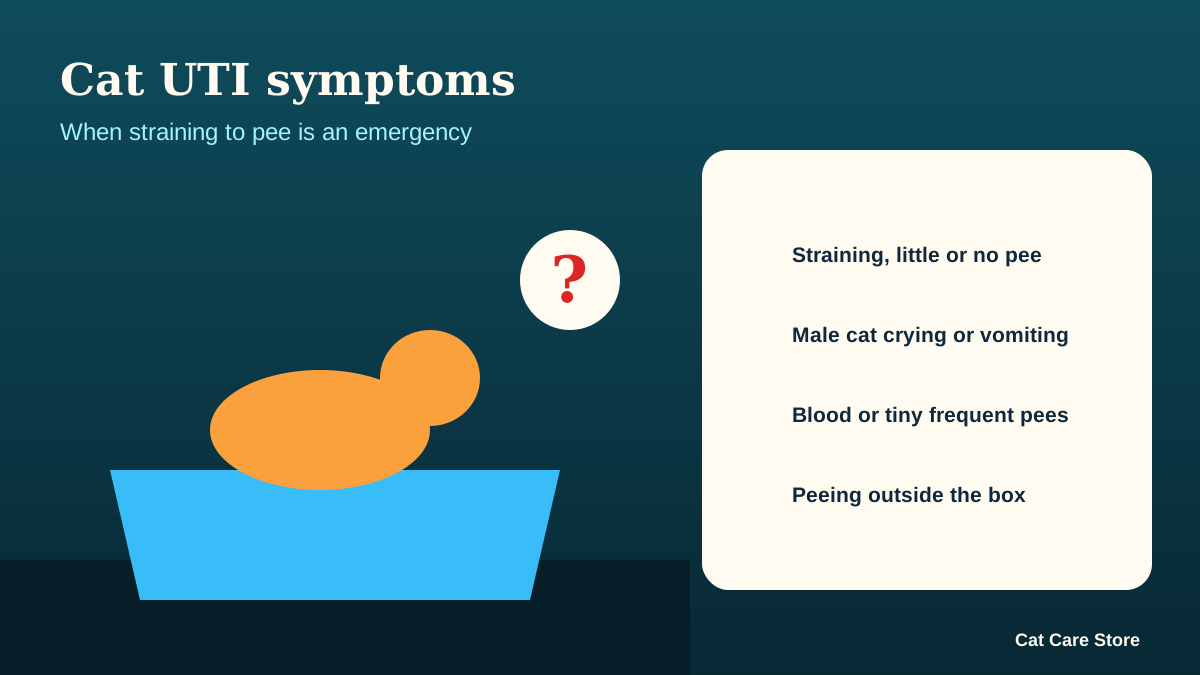
A male cat straining in the litter box and passing little or no urine needs a vet immediately, day or night. Cornell describes urethral obstruction as an absolute emergency and a potentially life-threatening condition, and notes that male cats are at higher risk because of the anatomy of their urinary tract. A blocked cat may look constipated, become restless or vocal, vomit or become lethargic. Do not wait to see if it passes.
Other medical reasons for accidents include kidney disease, diabetes, arthritis that makes climbing into a box painful, constipation or diarrhea, and cognitive changes in older cats. Because cats are good at masking illness, it helps to know the subtle signs in our guide to signs a cat is hiding illness. If you need a new clinic, see how to choose the right vet.
If the vet finds nothing
Once medical causes are ruled out, work through the setup checklist above: number of boxes, size, location, cleanliness and litter. Then look at stress. New pets, house moves, visitors, conflict with another cat or seeing outdoor cats through a window can all trigger house-soiling. More daily play helps many indoor cats; our guide to indoor cat exercise in a small apartment has easy routines. Never punish a cat for accidents, as it raises stress and usually makes the problem worse.
Frequently asked questions
How many litter boxes do I need for one cat?
Two. The common guideline from the AAFP, the ASPCA and the Humane Society of the United States is one box per cat plus one extra, placed in separate locations rather than next to each other.
How often should I completely change cat litter?
The ASPCA and Cats Protection both recommend scooping daily and fully emptying and washing the box about once a week. Change it sooner if you notice persistent odor or your cat starts avoiding the box.
Why does my cat pee right next to the litter box?
Cats Protection notes that toileting right beside the tray usually means your cat wants to use it but something is putting it off: the box may be dirty, too small, covered, or filled with litter it dislikes. Pain while squatting can also cause this, so check with your vet if it is new.
Is scented litter bad for cats?
Most cats prefer unscented litter. Cat Friendly Homes says perfumed litters and deodorizers are unpopular with many cats and can bother cats and people with asthma. If you want odor control, clean more often rather than adding fragrance.
Sources
- Cornell Feline Health Center, Feline Lower Urinary Tract Disease
- AAFP and ISFM (Journal of Feline Medicine and Surgery), AAFP and ISFM Guidelines for Diagnosing and Solving House-Soiling Behavior in Cats
- American Association of Feline Practitioners (Cat Friendly Homes), Everything You Should Know About Litter Boxes
- ASPCA, Litter Box Problems
- Humane Society of the United States, Preventing Litter Box Problems
- Cats Protection, Cat toileting problems
- ASPCA (cost estimates), Cutting Pet Care Costs; Cats Protection, Cost of owning a cat