How to Care for a 1-Month-Old Kitten: Feeding, Warmth and Vet Care
A four-week-old kitten is switching from milk to food. Here is how to wean, keep it warm, start the litter tray, track weight and plan vet care.
On this page
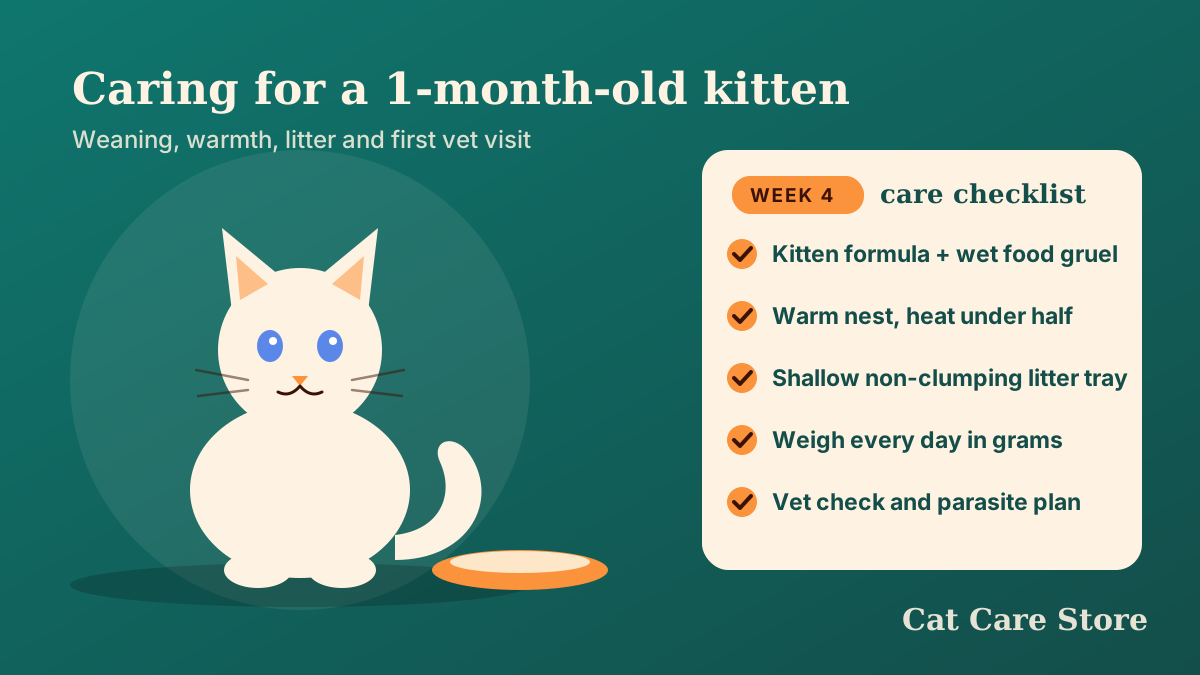
The short answer: a one-month-old (four-week-old) kitten is right at the switch from milk to solid food. Keep it warm, give it a shallow litter tray, offer a soupy mix of kitten formula and wet kitten food several times a day, weigh it every day, and book a vet check now so deworming and the vaccine plan start on time. If the mother cat is present and caring for the litter, let her do most of the work: kittens should stay with her until at least eight weeks old.
This is general information, not veterinary advice. Very young kittens can go downhill fast, so when in doubt, phone your vet or a local rescue.
First, check that the kitten really is about four weeks old
Care at this age is different from care at two weeks, so it is worth confirming. According to Alley Cat Allies' kitten age guide, a typical four-week-old kitten:
- weighs roughly 440–470 g (about 15.5–16.6 oz);
- has its small front teeth (incisors) and canines coming through;
- has fully upright ears and eyes that are still blue;
- walks steadily with its tail up and starts playing with littermates, toys and people.
A kitten that is much lighter, still wobbly, has no teeth or cannot pee and poo on its own is younger. Younger kittens need round-the-clock bottle feeding and help to toilet, so ask a vet or rescue for a neonatal care plan instead of following the weaning steps below.
Is the mother cat around?
If you found kittens outdoors, do not scoop them up straight away. Alley Cat Allies advises watching from a distance for a few hours, because the mother is often nearby and comes back. She feeds, cleans and teaches kittens far better than any person can.
If she is caring for them, your jobs are simpler: give her plenty of kitten food (it is richer, which helps while she nurses), keep the nest quiet and warm, and arrange a vet check for the whole family. The rest of this guide is mainly for kittens being raised without their mother, or for helping her with weaning.
Feeding a one-month-old kitten: the weaning plan
Four weeks is when weaning gets serious. The goal over the next few weeks is to move from formula to kitten food without upsetting a small stomach.
Use kitten formula, never cow's milk
Use a commercial kitten milk replacer from a pet shop or vet. Cow's milk is a common mistake: many cats do not digest lactose well, and the diarrhoea it can cause dehydrates a kitten this size quickly. Goat's milk and plant milks are not suitable substitutes either.
Make a gruel and thicken it gradually
- Start runny. Mix kitten formula with a small amount of wet kitten food until it looks like thin soup. Offer it in a shallow saucer at room temperature. If a kitten does not understand, dab a little on its lips with a clean fingertip.
- Thicken over days, not hours. As the kittens lap confidently, reduce the formula so the mix becomes more wet food and less milk.
- Move to wet kitten food. Once they eat plain wet food well, you can also offer dry kitten food softened with formula or warm water, and later dry kitten food on its own alongside wet.
Most kittens are eating kitten food on their own by around eight weeks. Choose food labelled as complete for kittens or for growth; adult cat food does not meet a growing kitten's needs.
Keep the bottle as a back-up
Some kittens take to the saucer in a day; others need a week or two. If a kitten is not eating enough from the dish, keep topping up with formula from a kitten bottle. Feed it lying on its stomach, never on its back, with the bottle tilted, and let it burp afterwards on your shoulder or lap.
How often to feed
Guides differ on exact numbers. Alley Cat Allies says kittens can move towards two or three meals a day once they are eating solid food, but while they are still learning, many carers offer small meals four or more times a day. Let the scale guide you: if the weight keeps rising every day, the routine is working. Once kittens eat solids, always leave a shallow dish of fresh water, and wipe faces clean with a warm, damp cloth after meals.
Warmth and a safe nest
Kittens can regulate their own body temperature at around four to five weeks, but they still need a warm spot they can move to and away from. Line a box or small pen with soft bedding, keep it away from draughts and put a heat source under only half of it, such as a pet-safe heating pad on low under a towel. A kitten should never lie directly on a heat source.
One rule is worth remembering: warm a chilled kitten before you feed it. A kitten that feels cold to the touch cannot digest properly, so warm it slowly and call a vet if it stays cold, limp or weak.
Keep explorers in one kitten-safe room or pen: cables, gaps behind appliances, recliners and toilet bowls are real risks. Our cat-proofing guide lists the less obvious ones.
Start litter training now
Four weeks is the right time. Use a very shallow tray, such as a baking tray or a box lid with low sides, so small legs can climb in. Alley Cat Allies recommends non-clumping litter at this age, because curious kittens may eat litter and clumping types can swell.
Put kittens in the tray after each meal and after they wake up. Instinct does most of the work. If an orphaned kitten is still not toileting on its own, gently rub its rear end with a warm, damp cotton pad after meals and place the pad in the tray so it learns the smell. Adult tray mistakes (wrong place, wrong litter, dirty tray) apply to kittens too; see our litter box mistakes article.
Weigh the kitten every day
A digital kitchen scale that reads in grams is one of the most useful things you can own at this stage. Weigh each kitten at the same time each day, before a meal, and write it down. A healthy kitten gains weight steadily. A kitten that loses weight, or has not gained anything for a day or two, needs a vet check even if it seems fine, because kittens often look normal until they are seriously unwell.
Health care: vet visit, worms, fleas and vaccines
Book a vet check now. A vet can confirm age and sex, check hydration, eyes, ears, gums and belly (hernias), look for parasites and set a plan. If you are new to choosing a clinic, our questions to ask a vet list helps.
- Worms: roundworms are very common in young kittens. The Companion Animal Parasite Council (CAPC) recommends starting deworming at two weeks of age, repeating every two weeks until two months old, then moving to monthly parasite control. Use only a product and dose your vet picks for the kitten's weight.
- Fleas: a heavy flea burden can cause dangerous anaemia in a kitten this small. Many flea treatments are not licensed for very young or light kittens, and dog flea products that contain permethrin are highly toxic to cats, as International Cat Care warns. Ask your vet what is safe and use a fine flea comb in the meantime.
- Vaccines: under the 2020 AAHA/AAFP feline vaccination guidelines, the core vaccine against panleukopenia, herpesvirus and calicivirus (often called FVRCP) starts from about six weeks and is repeated every three to four weeks until the kitten is 16–20 weeks old. Rabies follows local law. At four weeks there is usually nothing to give yet, but this is the time to plan the schedule.
- Testing: found or rescued kittens are often tested for feline leukaemia virus (FeLV) and FIV; ask your vet when that makes sense.
Warning signs: call a vet the same day
- refusing food or the bottle for more than one or two meals in a row;
- weight loss, or no weight gain for a day or two;
- diarrhoea that lasts more than a day, repeated vomiting, or a swollen, hard belly;
- feeling cold, floppy or weak, or crying constantly;
- sneezing with crusty or closed eyes, or breathing with effort;
- pale gums, or lots of fleas or flea dirt.
Small kittens have very little reserve: a problem an adult cat could ride out for a day can become an emergency within hours. Our guide to the subtle signs a cat is unwell covers older cats, but the same habit of noticing small changes starts now.
Play and socialising
Weeks four to seven are a key window for kittens to learn that people are safe. Alley Cat Allies suggests handling kittens often and playing with them for at least two hours a day in total, split into short sessions, with some time for each kitten on its own. Stay in the room while they eat so they link you with food.
Use toys rather than hands for rough play, so they do not learn that biting and scratching skin is a game. Simple toys work: a paper ball, a feather on a string or a cardboard box. As our cat toys article found, cats rarely need expensive kit.
Frequently asked questions
Can a four-week-old kitten eat dry food?
Not as its main food yet. Start with gruel and wet kitten food, then add dry kitten food softened with formula or water as weaning progresses.
Can I bathe a one-month-old kitten?
Avoid full baths, because a wet kitten chills fast. Spot-clean with a warm, damp cloth and dry it straight away. Ask a vet before using any shampoo, especially flea shampoo.
When can a kitten leave its mother?
Not before eight weeks. Kittens learn feeding, toileting and social skills from their mother and littermates, and many rescues prefer to wait a little longer.
Sources
- Alley Cat Allies, Kitten Guide: Four Weeks and Kitten Progression At-a-Glance
- Companion Animal Parasite Council, General Guidelines for Dogs and Cats
- AAHA/AAFP, 2020 Feline Vaccination Guidelines (vaccine table); full guidelines in the Journal of Feline Medicine and Surgery
- International Cat Care, Permethrin poisoning