Cat Food for a Sensitive Stomach: What Helps and When to See a Vet
Vomiting or loose stools? Rule out illness first, then switch food slowly, feed smaller meals and know when a vet-led food trial is the next step.
On this page
The short answer: there is no single best food for a cat with a "sensitive stomach", because the phrase covers several different problems. Start by ruling out the things food cannot fix, then make one change at a time: a complete and balanced diet that agrees with your cat, introduced slowly over seven to ten days, fed in smaller meals, with treats and extras cut back. If the vomiting or loose stools continue, the most useful next step is a vet-guided food trial, not another bag from the shelf.
This is general information, not veterinary advice. Persistent stomach trouble in cats is often a sign of something that needs a proper diagnosis.
What "sensitive stomach" usually means
On a bag of food, "sensitive stomach" is a marketing description rather than a medical category. At home, owners tend to use it for a few different patterns:
- vomiting soon after meals, often when the cat has eaten quickly;
- soft stools or diarrhoea that come and go;
- a cat that seems fine on one food and unsettled on another;
- hairballs that seem to come up more often than they should.
Some of these are minor. Others are early signs of conditions such as food allergy, inflammatory bowel disease, parasites, kidney disease or an overactive thyroid. Cornell's Feline Health Center lists all of these among the causes of frequent vomiting, which is why a food swap should never be the only thing you try.
Check first: when it is not a food problem
Even healthy cats vomit now and then, and the Cornell Feline Health Center says bringing up a hairball every week or two can happen without lasting problems. It also says a cat should be seen by a vet promptly if it:
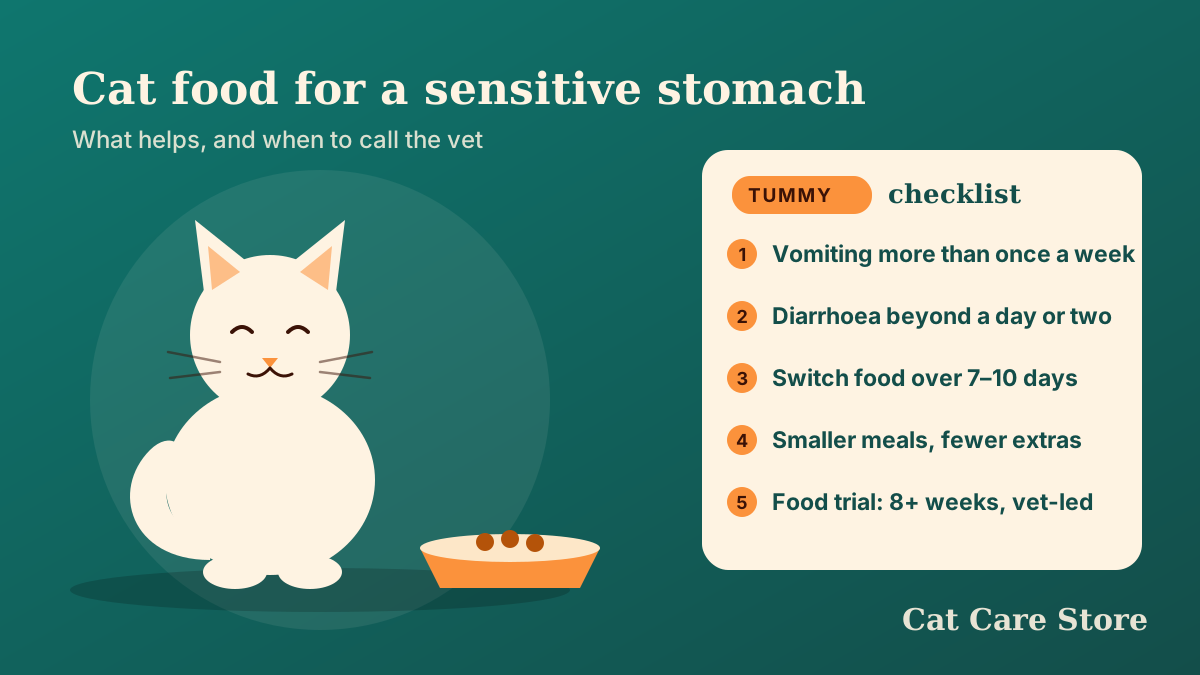
- vomits more often than once a week;
- seems lethargic or weak, or is eating less;
- has blood in its vomit;
- is drinking more, or urinating more or less than usual;
- has diarrhoea at the same time.
For diarrhoea, Cornell advises veterinary care as soon as possible if it lasts longer than a day or two and the cat also has a poor appetite, lethargy or vomiting. It also warns that some over-the-counter medicines made for people can harm cats, so do not reach for the family medicine cabinet.
One more rule matters here: do not starve a cat to "rest" its stomach unless your vet tells you to. The University of Illinois College of Veterinary Medicine notes that a cat that goes without eating for a few days in a row is at risk of hepatic lipidosis, a potentially fatal liver condition. If your cat has stopped eating, read our account of what happened when our cat stopped eating and call the vet.
Food changes that genuinely help
If your vet has ruled out illness, or the signs are mild and occasional, these changes are worth trying. Make them one at a time so you can tell what made the difference.
1. Switch slowly
Cornell notes that an abrupt change of diet can cause diarrhoea for a few days. Most vets suggest moving to a new food over seven to ten days: about a quarter new food for the first few days, then half and half, then three-quarters, then all new. Cats with a history of stomach trouble may need to go even slower. If the stools loosen, stay at the last step that suited them for a few more days.
2. Make sure the food is complete and balanced
Whatever you choose, look for the nutritional adequacy statement on the label. Cornell explains that minimum nutritional requirements for cats are set by AAFCO, and that reading the label is the best way to compare foods. A "complete and balanced" statement for your cat's life stage matters more than words like "gentle" or "natural" on the front of the pack.
3. Feed smaller meals more often
Cats that wolf down a large meal and bring it back up minutes later often do better with the same daily amount split into three or four smaller meals. A puzzle feeder or a flat plate that spreads the food out can slow down a fast eater. In a multi-cat home, competition at the bowl makes cats eat faster, so it can help to feed them apart. Our guide to feeding multiple cats without food wars has a few practical set-ups.
4. Cut back on extras
Treats, table scraps, milk and "just a bit of chicken" all count as part of the diet. If your cat is unsettled, stop the extras for a couple of weeks and see whether things improve. Cornell also advises against giving supplements without a vet's approval when a cat already eats a complete diet.
5. Store food properly
Cornell warns that dry food stored for too long loses vitamin potency and that its fats can go rancid. Keep dry food in an airtight container, check the date, and refrigerate opened cans. Spoiled food is a simple, avoidable cause of vomiting.
6. Think about moisture
Canned food is at least 75 percent water, according to Cornell, while dry food holds only six to ten percent. Some cats tolerate one format better than the other. If you change format, use the same slow switch.
Food allergy and the elimination trial
If the problem keeps coming back, your vet may suspect an adverse reaction to food. VCA Animal Hospitals explains that food allergies in cats are most often linked to proteins such as beef, fish and chicken, and to dairy. A cat can react to something it has eaten happily for years. Many allergic cats show itchy skin and over-grooming, and some also have vomiting or diarrhoea.
According to VCA, the only reliable way to diagnose a food allergy is an elimination diet trial lasting at least eight weeks. Your vet will choose either a hydrolysed protein diet, where proteins are broken down too small to trigger the immune system, or a novel protein diet using a protein your cat has never eaten. Home-cooked trial diets need to be formulated by a veterinary nutritionist.
Rules for the trial are strict: the cat eats only the prescribed food and water, with no treats, flavoured medicines or licked plates. If the signs settle and then return within about a week of going back to the old food, that confirms the diagnosis.
Ask your vet before using an off-the-shelf "limited ingredient" food for this. The trial only works if your cat eats nothing it has met before, so the vet will want to choose the diet.
When the vet suspects inflammatory bowel disease
Cornell describes inflammatory bowel disease (IBD) as chronic inflammation of the gut that is most common in middle-aged and older cats. Signs include vomiting, weight loss, diarrhoea and a reduced appetite. Diet is usually part of treatment: vets often start with a hypoallergenic food trial, commonly based on rabbit, duck or venison. If that does not help, a high-fibre, low-fat, easily digestible diet may be tried. Cornell notes that it can take several weeks or longer to see improvement after a diet change, so patience matters.
IBD can look very like intestinal lymphoma, and confirming it needs tests that only your vet can arrange. If your older cat is losing weight as well as being sick, our article on changes to expect in senior cats explains which changes are normal and which are not.
Keep a simple two-week log
The most useful thing you can bring to a vet appointment is a record. For two weeks, note:
- what your cat ate, how much and when, including treats;
- each episode of vomiting: time, how soon after a meal, and what came up (food, hair, foam or bile);
- what the stools looked like and how often they came;
- your cat's weight at the start and end, if you can weigh it;
- any change at home: a move, a new pet, visitors, a new litter.
Patterns often jump out. Vomiting whole food within minutes of eating points one way; vomiting bile hours after a meal points another. Cats are good at hiding illness, as our guide to subtle signs a cat is unwell explains, so small details matter. If you need a new clinic, these questions to ask when choosing a vet will help.
Frequently asked questions
Is wet or dry food better for a cat with a sensitive stomach?
Neither is better for every cat. Some cats keep wet food down more easily, while others do well on a dry diet. Choose a complete and balanced food, change formats slowly, and judge by your cat's stools, weight and vomiting frequency over a few weeks.
How long does it take for a new food to settle a cat's stomach?
Allow the seven to ten days of the switch, then two to four weeks on the new food before judging it. For a vet-run allergy trial, VCA advises at least eight weeks.
Are hairballs a sign of a sensitive stomach?
An occasional hairball is normal. Frequent hairballs, or retching with nothing coming up, are worth discussing with your vet. Regular brushing reduces the hair your cat swallows; see our guide to grooming a long-haired cat.
Sources
- Cornell Feline Health Center, Vomiting, Diarrhea, Inflammatory Bowel Disease and Feeding Your Cat
- VCA Animal Hospitals, Food Allergies in Cats
- University of Illinois College of Veterinary Medicine, Hepatic Lipidosis: When Cats Don't Eat
- PetMD, How To Switch Cat Food