Cheap Wet Cat Food: How to Tell a Good Budget Can From a Bad One
A low price is fine if the can says complete and balanced for your cat's life stage. How to read the label, compare cost per calorie and stretch a budget safely.
On this page
The short answer: cheap wet cat food can be perfectly good food. The price and the brand tell you very little. What matters is printed in small type on the can: a "complete and balanced" statement for your cat's life stage, a product name that tells you how much of the named meat is inside, protein and moisture figures you can compare fairly, and the calories per can. Check those four things, compare prices per calorie instead of per can, and you can feed a cat well on a tight budget.
This is general information, not veterinary advice. If your cat has a medical condition or eats a prescription diet, speak to your vet before you change foods.
Why "cheap" and "healthy" are not opposites
Lists of "cheap but healthier" wet food brands circulate on video and social feeds all the time. Brand rankings age badly: recipes change, one brand often sells complete meals and toppers side by side, and a can in one country may not match the same brand elsewhere. A label check works on any can, in any shop, on the day you buy it.
Price is not a reliable quality signal in either direction. Cornell's Feline Health Center notes that canned food is generally the most expensive type of cat food, but also a useful source of water, with at least 75 percent moisture, and very palatable to most cats. Cornell also warns that some gourmet canned foods may be nutritionally incomplete. Paying more does not guarantee a complete meal, and paying less does not rule one out.
Step 1: Find the "complete and balanced" statement
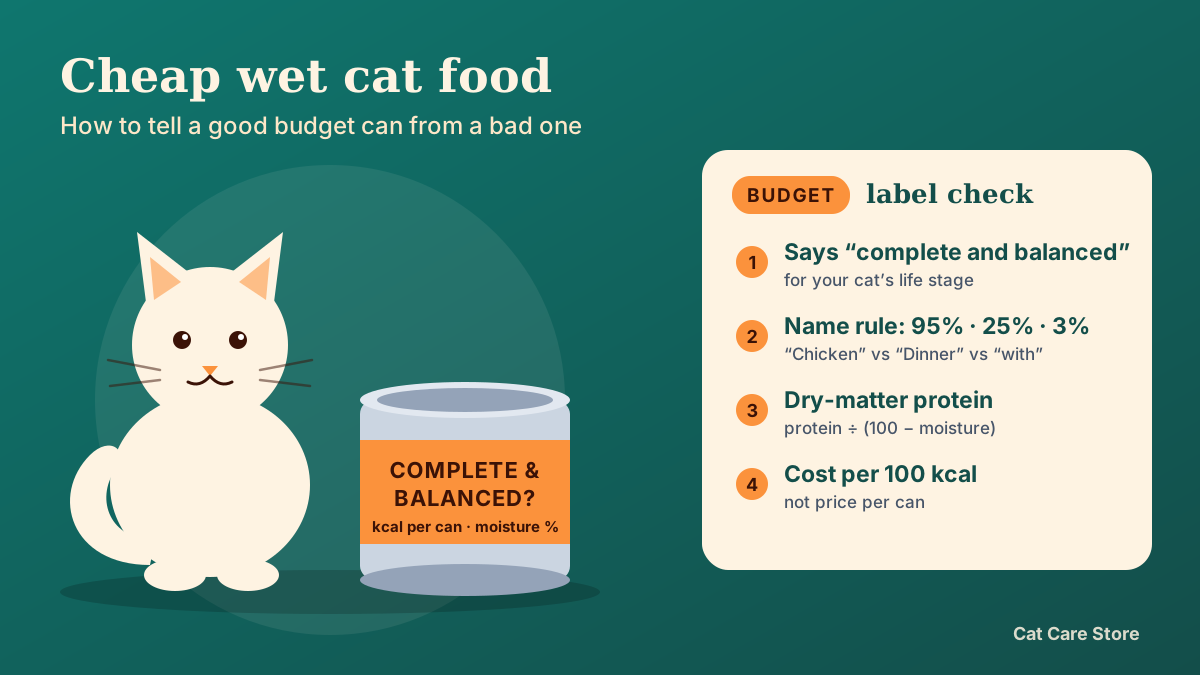
This is the most important line on the can, usually on the back or side in small print. In the US, the Association of American Feed Control Officials (AAFCO) explains that a complete and balanced cat food carries one of these standard wordings:
- "[Product] is formulated to meet the nutritional levels established by the AAFCO Cat Food Nutrient Profiles for [life stage]."
- "Animal feeding tests using AAFCO procedures substantiate that [product] provides complete and balanced nutrition for [life stage]."
"Complete" means the food contains all the nutrients a cat needs; "balanced" means they are in the right ratios. AAFCO recognises four life stages: gestation/lactation, growth, maintenance and all life stages. An adult cat can eat a maintenance or all-life-stages food. A kitten needs growth or all life stages, which is why our guide to caring for a young kitten keeps coming back to the label.
The red-flag wording is: "This product is intended for intermittent or supplemental feeding only." AAFCO gives a can of tuna sold for cats as an example of a product that does not provide complete nutrition. Such cans are fine as an occasional extra. Bargain shoppers get caught out because a topper or broth pouch can sit next to complete meals at the same price.
In the UK and Europe, look for "complete" or "complementary" pet food. The European pet food federation FEDIAF defines a complete pet food as one that, by its composition, is sufficient for a daily ration; a complementary food is not. Many cans sold in India and the Gulf are imported and carry one of these wordings. If you cannot find any statement that the food is complete, treat it as a side dish, not a meal.
Step 2: Read the product name, not the picture
The words in a pet food's name follow fixed rules, set out in AAFCO's label guide. They tell you roughly how much of the named ingredient is in the can:
- "Chicken Cat Food" (the 95% rule): the named ingredient must be at least 95% of the product by weight not counting added water, and at least 70% including it.
- "Chicken Dinner", "Entrée" or "Platter" (the 25% rule): at least 25% not counting added water, and at least 10% of the total.
- "Cat Food with Chicken" (the "with" rule): at least 3% of the named ingredient.
- "Chicken Flavor" (the flavor rule): no minimum amount; a listed ingredient only has to provide the flavour.
A "dinner" is not a bad food; a 25% recipe can still be complete and balanced. The rules help you compare like with like and avoid paying extra for a picture of a salmon fillet on a "salmon flavor" can.
Ingredients are listed in descending order by weight, and water or broth often sits near the top of a wet food list because it is heavy. Cornell suggests looking for foods where meat, meat byproducts or seafood are among the first few ingredients, because cats are obligate carnivores that rely on nutrients found in animal products.
Step 3: Compare protein on a dry-matter basis
The guaranteed analysis lists minimum crude protein, minimum crude fat, maximum crude fibre and maximum moisture. Wet foods are around three-quarters water, so their protein figures look tiny next to kibble. To compare fairly, take the water out of the sum:
Dry-matter protein = protein % ÷ (100 − moisture %) × 100
- Can A: 10% protein, 78% moisture → 10 ÷ 22 × 100 = about 45% on a dry-matter basis.
- Can B: 8% protein, 82% moisture → 8 ÷ 18 × 100 = about 44%.
- A dry food with 32% protein and 10% moisture → 32 ÷ 90 × 100 = about 36%.
Cans A and B look different on the shelf but are almost identical once the water is removed. These figures are guaranteed minimums and maximums, not exact amounts, so use the sum to spot big gaps, not to split hairs.
Step 4: Work out the price per calorie, not per can
Cans and pouches differ in size and energy, so a cheap-looking pouch can cost more to feed than a bigger can. Many labels show calories as kcal per kg and kcal per can or pouch; if yours doesn't, the manufacturer should be able to tell you.
Cost per 100 kcal = price ÷ kcal per can × 100
Example, in any currency: a can costing 1.10 that provides 130 kcal works out at about 0.85 per 100 kcal. A pouch costing 0.70 that provides 70 kcal costs 1.00 per 100 kcal. The pouch is cheaper per item but around 18% dearer per calorie.
For your daily cost, ask your vet for your cat's daily calorie target, which depends on weight, age, activity and neutering. Then multiply: daily kcal ÷ 100 × cost per 100 kcal. The same target tells you how many cans to feed: daily kcal ÷ kcal per can.
Step 5: Ask who makes it
Store brands and smaller labels are often made by contract manufacturers, so the logo tells you less than a few straight answers. The World Small Animal Veterinary Association (WSAVA) suggests asking a pet food company:
- Do you employ a full-time qualified nutritionist, such as a board-certified veterinary nutritionist or someone with a PhD in animal nutrition?
- Who formulates your foods, and what are their credentials?
- Are your foods tested with AAFCO feeding trials, or formulated to meet AAFCO (or FEDIAF) nutrient profiles?
- Where are your foods made, and what quality control do you use?
- Can you provide a complete nutrient analysis and the calorie content of this food?
Clear, quick answers are a good sign at any price. Vague talk of "natural" or "premium" ingredients is not an answer.
Ways to stretch a wet-food budget safely
- Mix wet and dry. Cornell describes dry food as relatively inexpensive. A complete dry food plus one complete wet meal a day costs far less than all-wet; count the calories from both so the total stays on target.
- Buy the bigger can if your cat finishes it. Larger cans are usually cheaper per calorie. Refrigerate the unused portion, as Cornell advises, and use it up quickly.
- Rotate only between complete foods. Chasing offers is fine if both foods are complete and you change over gradually; our guide to cat food for a sensitive stomach explains the seven-to-ten-day switch.
- Keep toppers and treats as extras. They are often the most expensive food per calorie in the cupboard.
- Portion by cat, not by bowl. With more than one cat, our tips on feeding multiple cats without food wars keep each cat on its own ration.
One thing not to do to save money: switch to raw or improvised home-made meals. Cornell does not recommend raw diets because of the risk of bacteria and parasites, and home-made food is hard to balance without a recipe from a veterinary nutritionist.
When the cheapest can is not the right call
- Prescription or therapeutic diets. Foods for kidney or urinary disease are deliberately restricted in certain nutrients. Don't swap them for a shop brand without your vet's say-so.
- Older cats. Appetite, teeth and weight change with age; our guide to senior cat changes covers what is normal.
- A cat that refuses the new food. Never let a cat go hungry while it "gets used to" a cheaper food. The University of Illinois College of Veterinary Medicine warns that a cat that stops eating for a few days can develop hepatic lipidosis, a serious liver condition. Go back to the old food and read what to do when a cat stops eating.
Your vet can help you plan a budget diet, and if you are choosing a new practice, these questions to ask a vet are a good start.
A 60-second label check in the shop
- Does it say "complete and balanced" (or "complete" in Europe) for your cat's life stage?
- Does the name say "Chicken", "Chicken Dinner", "with Chicken" or "Chicken Flavor", and is that what you want to pay for?
- Is a meat, meat byproduct or fish among the first few ingredients?
- How does the dry-matter protein compare with your current food?
- How many kcal per can, and what is the cost per 100 kcal?
Frequently asked questions
Is cheap wet cat food bad for cats?
Not if it is complete and balanced for your cat's life stage and your cat does well on it. Judge it by weight, coat, energy and stools over several weeks, not by the price.
How many cans of wet food does a cat need a day?
Divide your cat's daily calorie target by the kcal per can. The label's feeding guide is a starting point; adjust it with your vet based on your cat's body condition.
Sources
- AAFCO, Reading Labels: How to Understand a Dog or Cat Food Label and Selecting the Right Pet Food
- Cornell Feline Health Center, Feeding Your Cat
- WSAVA Global Nutrition Committee, Guidelines on Selecting Pet Foods
- FEDIAF, Nutritional Guidelines for Complete and Complementary Pet Food for Cats and Dogs
- University of Illinois College of Veterinary Medicine, Hepatic Lipidosis: When Cats Don't Eat