Cat UTI Symptoms: When Straining to Pee Is an Emergency
Straining with little or no urine, especially in a male cat, needs a vet today. Which urinary signs are emergencies, why most aren't infections, what helps.
On this page
The short answer: a cat that keeps going back to the litter box, squats and strains but passes little or no urine needs a vet today, not tomorrow. If that cat is male, or is crying, vomiting, hiding or lethargic, treat it as an emergency and call your vet or the nearest emergency clinic now. A blocked urethra stops urine leaving the body, and Cornell's Feline Health Center warns that the time from a complete blockage to death can be less than 24 to 48 hours.
Most other urinary signs, such as peeing small amounts often, blood-tinged urine or peeing outside the box, are still worth a vet appointment within a day or two. They are rarely a simple "UTI" in the way people think of it, which is why home remedies and leftover antibiotics are the wrong move. This guide is general information, not veterinary advice; it explains what the signs mean and how urgent each one is.
Cat UTI symptoms to watch for
Vets group these under lower urinary tract signs (LUTS). The AVMA, Cornell and International Cat Care (iCatCare) list the same core set:
- Straining in the litter box, or sitting in it for a long time
- Frequent trips to the box, passing only small amounts each time
- Crying out or growling while peeing
- Blood in the urine (pink, red or rusty clumps; sometimes only visible on a vet's test)
- Peeing outside the box, often on cool, smooth surfaces such as bathtubs, sinks or tile
- Licking the genital area a lot, sometimes until the belly or inner thighs go bald
- Behavior changes: hiding, irritability, not wanting to be touched or picked up
VCA Animal Hospitals notes that owners often mistake straining to pee for constipation. If you can't tell which it is, look at the litter: a clump-free box after several attempts is a red flag, not a reassurance.
When straining to pee is an emergency
The dangerous problem is urethral obstruction, a blockage of the tube that carries urine out of the bladder. It happens mostly in male cats, including neutered males, because their urethra is longer and narrower. Cat Friendly Homes (the American Association of Feline Practitioners' owner site) says it affects fewer than 10% of cats with urinary signs, but it is a true emergency when it does.
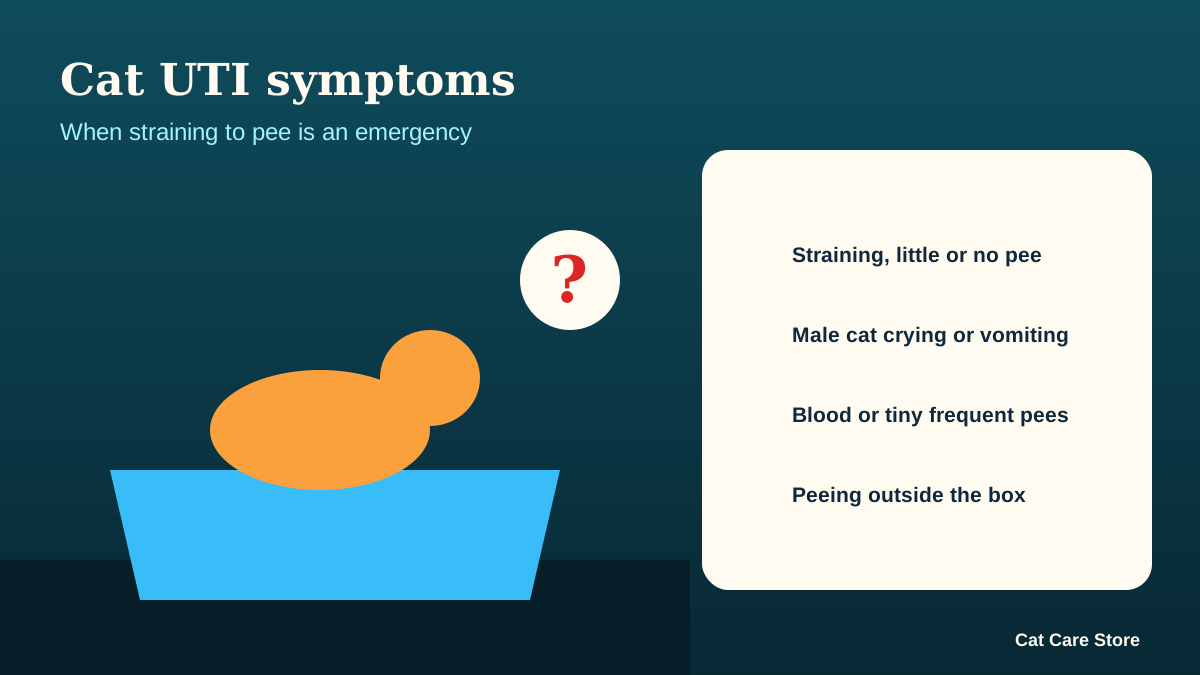
Go now, day or night, if you see:
- Repeated straining with no urine, or only a few drops
- Crying in pain, especially in the box or when the belly is touched
- Vomiting, drooling or refusing food
- Lethargy, hiding, weakness, or trouble standing
- A male cat with any urinary signs whose behavior is getting worse over hours
When urine cannot get out, waste products and potassium build up in the blood. The MSPCA-Angell animal hospital in Boston explains that a cat left untreated for 24 hours or more can deteriorate rapidly, and that early signs (extra trips to the box, licking, more vocalizing) are easy to dismiss as a minor bladder infection. Its advice is blunt: any cat straining in the litter box should be seen by a vet.
Don't try to "wait and see" overnight, and don't press on your cat's belly to check the bladder yourself. A blocked bladder can be painful and fragile. Call ahead so the clinic can get ready; you can use our checklist of questions to ask a vet clinic to find out now whether yours sees emergencies or which after-hours hospital it uses.
Why most "cat UTIs" aren't infections
This surprises a lot of owners. In young and middle-aged cats, a bacterial urinary tract infection is uncommon. Here is roughly what vets find when they investigate urinary signs:
- Feline idiopathic cystitis (FIC): painful bladder inflammation with no single identifiable cause. iCatCare puts it at around 60 to 70% of cases, and stress plays a major role.
- Bladder stones (uroliths): mostly struvite or calcium oxalate. iCatCare estimates they account for about 10 to 15% of cases.
- Urethral plugs: a soft mix of protein, cells, crystals and debris that can block a male cat's urethra.
- Bacterial infection: Cat Friendly Homes reports it in fewer than 5% of younger cats with urinary signs. It is more common in cats 10 years and older, especially those with kidney disease or diabetes, according to the AVMA.
- Less common causes: tumors, injuries and anatomical defects.
So a "UTI" in a 4-year-old indoor cat is usually not an infection at all, and antibiotics alone won't fix it. In a 14-year-old cat, an infection is more likely and may be a clue to another illness. Either way, a urine test is what tells the two apart.
Which cats are most at risk?
Any cat can develop urinary signs, but the AVMA, Cornell and the PDSA describe a familiar profile:
- Middle-aged cats (VCA gives an average onset of about four years)
- Male and neutered cats, with males at higher risk of a blockage
- Overweight cats that get little exercise
- Indoor cats with little or no outdoor access
- Cats that drink little and eat mostly dry food
- Cats in multi-cat homes, or living through change: a move, a new baby or pet, building work, a change of food, even a change in weather
If several of these describe your cat, it is worth learning the warning signs now rather than in the middle of the night.
What happens at the vet
Expect a physical exam and a urinalysis, which checks concentration, pH, blood, crystals and signs of inflammation or infection. If the first round of treatment doesn't work or the signs come back, the AVMA and Cornell list the next steps: a urine culture, bloodwork, and X-rays or ultrasound to look for stones.
Treatment depends on the cause:
- FIC: pain relief, more water in the diet, and stress reduction. Cornell notes that signs often settle within a couple of weeks, so the real goal is preventing the next flare.
- Bacterial infection: antibiotics chosen from culture results where possible.
- Stones: struvite stones can sometimes be dissolved with a prescription diet; calcium oxalate stones cannot, and usually need to be removed.
- Blockage: sedation or anesthesia, a urinary catheter to clear the urethra, IV fluids to correct dehydration and electrolytes, and a hospital stay that Cornell says can run from a few days to several weeks. Cats that block repeatedly may be offered surgery (perineal urethrostomy).
What a blockage can cost
Treatment for a blocked cat is one of the bigger emergency bills owners face, largely because of the hospital stay. On October 21, 2026, Finder reported RSPCA Pet Insurance claims data from Australia showing urinary blockage treatment costing between A$500 and A$13,500, depending on the case. Costs in the US and UK vary widely by clinic and by how long the cat stays in, so ask for an itemized estimate before treatment and ask what the clinic's payment options are. Waiting for a weekday appointment to save money usually backfires: a cat that has been blocked longer is sicker and needs longer care.
How to lower the risk of another episode
None of this replaces the plan your vet gives you, but these steps are backed by Cornell, iCatCare, the PDSA and the Merck Veterinary Manual:
- Get more water into your cat. Wet food is the simplest way; Merck lists canned food among the standard measures for FIC. If budget is the worry, here is how to choose a good budget wet food. Water fountains and several wide bowls away from the food help some cats drink more.
- Keep the litter box easy to use. Enough boxes (one per cat plus one), scooped daily, in quiet spots. Our guide to litter box mistakes covers number, placement and litter type.
- Reduce stress and conflict. Separate food, water, beds and hiding places for each cat; see feeding multiple cats without food wars. Daily play helps too; try this indoor play plan.
- Change food slowly and keep routines steady. The PDSA lists a change of food among common FIC triggers, and Cornell says diet and feeding schedule should stay consistent.
- Plan ahead for stressful events. Moves, guests and loud seasons such as fireworks season are known triggers; watch litter box habits closely for a few days afterward.
- Use urinary diets only on a vet's advice. Cornell notes that "urinary health" foods may reduce the chance of a blockage in cats with FIC, but there is no evidence they reduce urinary signs on their own. Stone-dissolving diets are prescription products for a specific stone type.
Cats are good at hiding discomfort, so small changes count. Our guide to subtle signs a cat is unwell is a useful companion, and older cats should have urine checked as part of routine care, as explained in our senior cat guide. A cat that is also refusing food needs prompt attention; see what to do when a cat stops eating.
Frequently asked questions
Can a cat UTI go away on its own?
Some episodes of idiopathic cystitis do settle within a couple of weeks, but you can't tell at home whether your cat has FIC, an infection, stones or a developing blockage. A urine test is the only way to know, and a blockage can become fatal in a day or two.
Is cranberry safe for cats with urinary problems?
Ask your vet first. The Merck Veterinary Manual says supplements for feline urinary disease have not been studied extensively, with only preliminary evidence for cranberry extract. Never use human cranberry products, which can contain sugar or other ingredients that aren't suitable for cats.
Can female cats get blocked?
It is much less common, because a female cat's urethra is shorter and wider, but it can happen. Any cat straining with no urine coming out should be seen urgently.
How can I tell straining to pee from constipation?
Check the litter after the attempts. No urine clumps, or only tiny ones, point to a urinary problem. If you are unsure, assume it could be urinary and call your vet; it is the more dangerous of the two.
Sources
- Cornell University College of Veterinary Medicine, Cornell Feline Health Center, Feline Lower Urinary Tract Disease
- American Veterinary Medical Association (AVMA), Feline lower urinary tract disease (FLUTD)
- International Cat Care (iCatCare), Feline Lower Urinary Tract Disease
- Cat Friendly Homes (AAFP), Lower Urinary Tract Disease
- VCA Animal Hospitals, Cystitis and Lower Urinary Tract Disease in Cats
- PDSA, Feline Idiopathic Cystitis (FIC)
- MSPCA-Angell, Urethral Obstruction in Cats
- Merck Veterinary Manual, Lower Urinary Tract Disease in Cats
- Finder, The sky-high vet bill most cat owners aren't prepared for (October 21, 2026)