Cats and Fireworks: How to Keep Your Cat Calm From Bonfire Night to New Year's Eve
Bring cats in before dark, offer several hiding spots and let them choose. A vet-sourced fireworks plan for Bonfire Night, New Year's Eve and July 4.
On this page
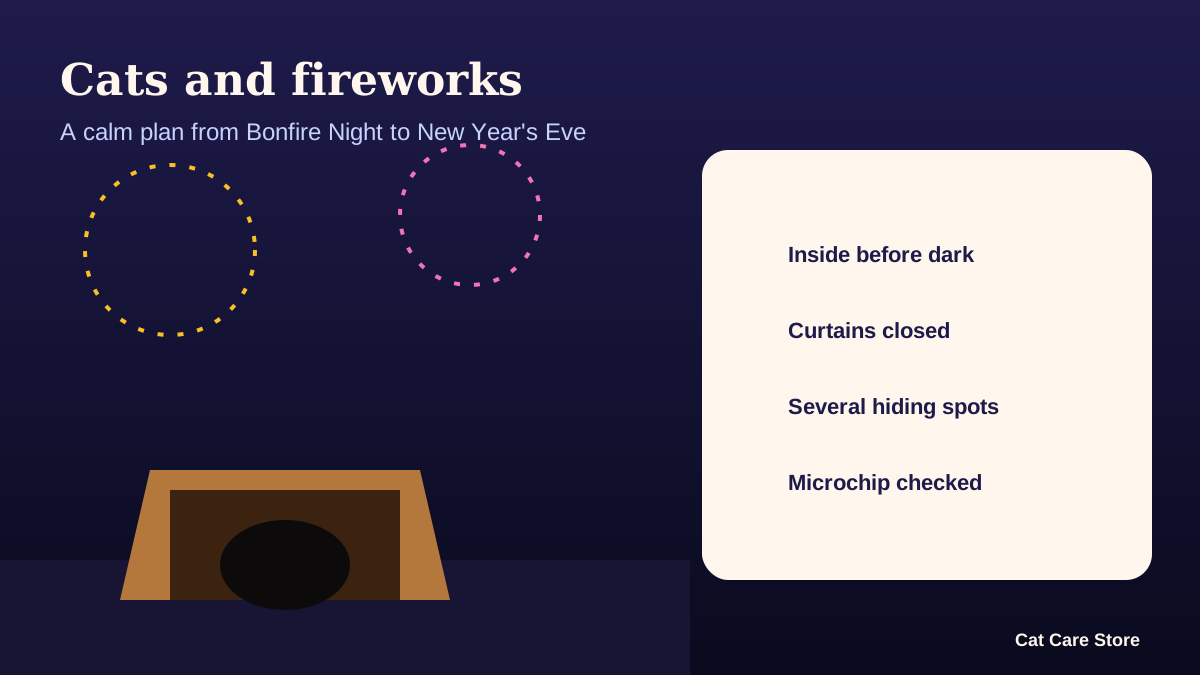
The short answer: bring your cat indoors well before dark, lock the cat flap and close the windows, draw the curtains, put some steady background sound on, and make sure your cat has several hiding places it can choose for itself, with food, water and a litter box close by. Then let your cat hide. Don't pull it out, hold it or shut it in one room. Most cats cope far better when they control where they wait out the noise.
Fireworks are not a one-night problem. In the UK, registered shops can sell fireworks from October 15 to November 10 and again from December 26 to 31, so bangs can start weeks before Bonfire Night on Thursday, November 5 and carry on through Diwali celebrations and New Year's Eve. In the US and Canada the same plan works for the Fourth of July, Canada Day and New Year's. This guide is general information, not veterinary advice. If your cat has been badly frightened in past years, book a vet appointment now rather than the week of the display.
How common is fireworks fear in cats?
More common than many owners expect, because frightened cats tend to go quiet rather than pace and bark. In the PDSA's Animal Wellbeing (PAW) Report, 30% of UK cat owners said their cat is afraid of fireworks, which the charity estimates is around 3.3 million cats. The ASPCA notes that noise phobias are less common in cats than in dogs but do happen, and that cats usually respond by hiding.
Cats hear sounds much more intensely than we do, and fireworks are loud, sudden and unpredictable. Cats Protection points out that cats are creatures of habit, so bangs and flashes take them by surprise and leave them feeling unsafe. A frightened cat that is outdoors may run, cross roads, or end up shut in a neighbor's garage or shed.
Signs your cat is scared
Watch for these during and after fireworks, based on guidance from the PDSA and Cornell's College of Veterinary Medicine:
- Hiding behind or on top of furniture, in closets or in odd, quiet places
- Cowering, trembling or pacing
- Trying to run away or get out of the house
- Peeing or pooping outside the litter box
- Refusing food, or drooling
- Seeking you out more than usual
Cornell warns that a panicking animal can injure itself trying to escape, and may bite or scratch someone who is only trying to calm it down. That is one more reason to let a scared cat stay where it has chosen to hide.
Two to three weeks before: get ready
- Check the microchip details. The PDSA and the AVMA both advise making sure your contact details on the microchip registry are current, so a cat that bolts can be returned. The AVMA also suggests taking a recent photo of your cat.
- Find out the dates. Check your local council, town or park listings for public displays near you. Private fireworks are harder to predict, so plan for the whole season, not one evening.
- Move dinner earlier. The PDSA suggests getting outdoor cats used to a slightly earlier mealtime a few weeks ahead, so they are in the habit of coming home before dark.
- Plug in a pheromone diffuser if you plan to use one. The PDSA and Cats Protection both suggest synthetic cat pheromones. For the best effect the PDSA recommends plugging the diffuser in a few weeks before the season starts and keeping it topped up until the season ends. If you use a spray instead, let it settle for about 15 minutes before your cat goes into the room.
- Start background sound early. If you'll use music or the TV on the night, the PDSA suggests starting a few days or weeks ahead so the sound becomes part of normal life rather than a signal that something odd is happening.
- Talk to your vet if fear has been severe before. See the medication section below. Cornell advises booking at least a week before the expected event.
Build a fireworks den (or three)
A den is simply a covered, enclosed space your cat can retreat into. A cardboard box on its side with a blanket over the top works, as does a cat carrier with the door off or a gap at the back of a closet. Put it in a quiet part of the home away from windows.
Offer more than one option, and include somewhere high, because many cats feel safer up on a wardrobe or bookshelf. Put a litter box nearby. The PDSA's rule for multi-cat homes is one tray per cat plus a spare, so cats don't have to cross each other's path to reach one. If you're not sure your setup is right, our guide to common litter box mistakes covers placement.
The reason for several spots is choice. The PDSA specifically advises against confining a cat to one room, because the confinement itself can add stress. Make the whole home safe and closed to the outside, then let your cat pick.
On the night: a simple checklist
- Get your cat inside well before dark. In the UK it is dark by about 5 p.m. in early November, and many people light fireworks right after sunset. Cats Protection's first tip is to keep cats indoors after dark.
- Close and lock everything. Shut windows, lock the cat flap, and be careful with outside doors. If you have guests, the AVMA suggests asking them to watch the doors and putting a note on exits.
- Close the curtains and switch the lights on to hide the flashes.
- Add steady sound. Music or the TV at a moderate volume helps mask the bangs. The PDSA notes classical music or something with a deeper bass can cover the noise, but keep it at a level your cat is comfortable with.
- Keep the routine normal. Feed at the usual time, play if your cat wants to, and act as you normally would. A treat-stuffed toy can be a useful distraction for a cat that is only mildly unsettled.
- Comfort, but don't force it. If your cat comes to you for reassurance, give it. If it wants to be alone, let it, and check on it quietly. The PDSA advises never picking up or restraining a frightened cat.
- Never punish fearful behavior, including an accident outside the litter box. The RSPCA is clear that pets can't help their fear response and that a negative reaction makes things worse.
- Keep fireworks, sparklers and glow sticks out of reach. The ASPCA notes that fireworks contain chemicals and heavy metals. If your cat chews one, call your vet or, in the US, the ASPCA Animal Poison Control Center at (888) 426-4435 (a fee may apply). Glow sticks are covered in our Halloween cat safety guide.
Why the usual dog advice doesn't fit cats
Much fireworks advice is written for dogs: shut them in a crate or a single room, put on an anxiety wrap, keep them close to you. Some of that can help a dog, but cats cope differently. A cat's instinct is to get somewhere small and high and wait. Pulling a cat out of a hiding place to cuddle it, or shutting it in a room it didn't choose, takes away the one coping strategy it has.
The cat version of "safe room" is a secure house with several hideouts, not a locked door. If you live in a small apartment, the same idea applies on a smaller scale: a covered box, a cleared shelf and the top of a wardrobe give three choices. Our apartment cat-proofing guide has ideas for making high spots safe.
Can your vet prescribe something for fireworks fear?
Yes. If your cat panics, hurts itself, stops eating or soils the house every year, ask your vet about it. Cornell says vets may prescribe anti-anxiety medication to give before known stressful events, and that it works best when it has been tried beforehand so the dose can be adjusted. The ASPCA also recommends a practice dose before the big night and never sharing medication between pets.
Two firm rules: don't give your cat any human medicine or sleep aid, and don't give a dog's calming product to a cat. Many medicines that are safe for people or dogs are dangerous for cats. Over-the-counter calming supplements exist, but the PDSA notes cats respond differently to them and some work better than others, so mention any you plan to use to your vet.
For long-term change, the RSPCA and the AVMA both point to gradual desensitization: playing recorded firework sounds very quietly while your cat eats or plays, and slowly raising the volume over weeks, only as long as your cat stays relaxed. It is best started months before the season, and a vet can refer you to a qualified behaviorist if you need help.
The morning after
- Check outside before letting your cat out. The AVMA advises checking your yard for fireworks debris first. Spent fireworks and sparkler wires can land in gardens.
- Expect a slow return to normal. Some cats stay jumpy for a day or two. Let your cat come out in its own time.
- Watch food, water and litter box use. A cat that hasn't eaten for more than a day needs a vet call; see what to do when a cat stops eating. Cats are good at hiding signs of illness, so don't put a change down to fireworks without checking.
- If your cat got out, search quietly close to home first, including sheds, garages and under decks, and call your microchip registry, local shelters and nearby vet clinics.
If your cat is still stressed days later, Cats Protection and the RSPCA both recommend speaking to your vet, who can rule out pain or illness and refer you to a behaviorist. If you don't yet have a vet you trust, here are the questions to ask when choosing one. Older cats, and cats with hearing or vision changes, may react differently; our guide to senior cat changes explains what to watch.
Frequently asked questions
Should I let my cat out on Bonfire Night?
No. Bring your cat in before dark, lock the cat flap and keep it in overnight. Fireworks often start right after sunset and can continue for several evenings around November 5 and New Year's Eve.
Should I comfort my cat during fireworks?
Yes, if your cat comes to you. Calm attention won't make the fear worse. Just don't pick up, hold or pull a hiding cat out of its spot, and stay calm yourself.
How long does fireworks season last for cats?
In the UK, from mid-October to around November 10, then again over New Year. Under UK law private fireworks must stop by 11 p.m., except until midnight on Bonfire Night and 1 a.m. on New Year's Eve, Diwali and Chinese New Year. In North America, plan around the Fourth of July, Canada Day and New Year's Eve.
Can I give my cat something to calm it down?
Only what your vet prescribes or approves. Never give human medicines or another pet's medication. Pheromone diffusers are low-risk and work best when plugged in a few weeks ahead.
Sources
- PDSA, Cats and Fireworks
- Cats Protection, Cats and fireworks
- RSPCA, Pets and fireworks
- ASPCA, Managing Pet Anxiety During Fourth of July Fireworks and Other Festivities
- American Veterinary Medical Association (AVMA), July 4 safety
- Cornell University College of Veterinary Medicine, Fireworks fears? Tips to protect your pets
- GOV.UK, Fireworks: the law