Halloween Cat Safety: Glow Sticks, Sweets, Costumes and Open Doors
Keep your cat in a quiet room, check its microchip details and keep sweets, glow sticks, candles and lilies out of reach. A vet-sourced Halloween guide.
On this page
The short answer: most Halloween problems for cats come from four things: a front door that keeps opening, glow sticks and decorations within paw's reach, sweets and wrappers left out, and the stress of an evening full of noise and strangers. Put your cat in a quiet, closed room before trick-or-treating starts, check that their microchip and ID details are current, and keep treats, glow sticks, lit candles and lilies out of reach. That covers most of what goes wrong for cats on the night.
This is general information, not veterinary advice. If you think your cat has eaten something harmful, call your vet or an animal poison helpline straight away. Don't wait for signs to appear.
Why Halloween is harder on cats than it looks
Cats like routine and a predictable territory. Halloween breaks both at once: the doorbell rings again and again, people in masks and capes appear at the door, and new objects show up on every shelf and windowsill. The American Veterinary Medical Association (AVMA) puts it simply: costumes, decorations and "a constant parade of strangers" are what put pets at risk of being hurt, poisoned or lost at Halloween.
For cats, the most serious risk is often the simplest one. A frightened cat can slip past someone's legs and out of an open door in the dark, then hide somewhere it would never normally go. Plan for that first, and the rest is easier.
1. The open door: set things up before dusk
The ASPCA advises that all but the most social cats and dogs should be kept in a separate, comfortable room away from the front door during peak trick-or-treating hours. In practice that means:
- Choose a safe room as far from the front door as you can, such as a bedroom or a quiet study. Put in a litter tray, water, a bed, a hiding place (a plain cardboard box works well, as we explain in our post on cardboard boxes versus expensive toys) and something that smells of you.
- Move your cat in early, before the first knock, not after the cat has already bolted under the sofa. A meal or a short play session in that room helps it feel like a normal evening.
- Tell everyone in the house. A note on the safe-room door ("Cat inside, keep closed") stops a visiting child or a busy family member from opening it.
- Check ID now, not on the night. The AVMA recommends a microchip, a collar and an ID tag. A microchip only helps if the registry has your current phone number, so log in and check it this week. For cats, choose a breakaway collar.
- Bring outdoor cats in before dark and keep them in until the next morning. The AVMA's advice for Halloween is to keep pets indoors. An indoor cat that is bored for one evening is better off than a lost one, and a little extra play helps (see indoor exercise ideas for small homes).
If your door is in constant use, it can be easier to sit outside with the sweets bowl for an hour. Fewer door openings means fewer chances to escape.
2. Black cats: a real but narrow concern
Every October, some rescues pause black-cat adoptions. On 23 October 2026, WRAL (reporting from WITN) said the Feline Freedom Society in eastern North Carolina had paused approvals of new black-cat adoption applications through 1 November, as it did last year, so it could vet adopters properly. A board member said most people see black cats positively but that some "do have negative intentions" around Halloween. Other shelters run similar pauses, while many do not.
The pause is a precaution, not proof that adopters mean harm. For owners the practical point is simple: if you have a black cat that normally goes out, keep it indoors this week. A dark cat is also hard for drivers to see on a busy evening.
3. Glow sticks and glow jewellery
Cats love glow sticks, and they bite them. ASPCA Animal Poison Control says pets, "especially cats", often bite and puncture them. Most glow sticks are labelled non-toxic, but the liquid tastes extremely bitter, so a cat that bites one may drool heavily and race around the house. The AVMA also says the liquid can make pets drool or act strangely, but is unlikely to be harmful.
If it happens:
- Take the glow stick away and wipe your cat's mouth and any wet fur with a damp cloth, so it doesn't keep licking the liquid off while grooming.
- Offer a small amount of tasty food. The ASPCA notes that a little treat usually stops the taste and the reaction.
- Call your vet if your cat swallowed pieces of plastic, keeps vomiting, or still seems unwell once the first few minutes have passed.
The easiest fix is prevention. Keep glow sticks on children, not on tables or the floor, and gather them up at the end of the night.
4. Sweets, wrappers and raisins
Cats are much less interested in sweets than dogs are, but they still lick, bat and chew things left on low tables. The main hazards:
- Chocolate. The ASPCA warns that chocolate in all forms, especially dark or baking chocolate, can be very dangerous for cats and dogs. Pet Poison Helpline explains that chocolate contains theobromine and caffeine. Too much can cause vomiting, diarrhoea, a fast heart rate, tremors and seizures, and the risk depends on the type and amount eaten and the size of the animal. A small cat needs much less than a large dog to get into trouble.
- Raisins and sugar-free sweets. The AVMA says raisins can cause kidney failure in pets and that sugar-free sweets and gum may contain xylitol. Most of the evidence on xylitol comes from dogs, where the ASPCA calls it life-threatening. It is less clear how it affects cats, so treat it as a reason to keep sweets away, not as something to test.
- Wrappers, foil, lollipop sticks and ribbon. These cause choking or a blockage in the gut, not poisoning. String-like items such as ribbon, curling ribbon, tinsel and stretchy fake cobweb are a particular worry with cats, because a swallowed strand can seriously injure the intestines. If you see string hanging from your cat's mouth or bottom, do not pull it. Call your vet the same day.
As the AVMA points out, you often can't tell what a sweet contains just by looking at it. Keep sweets in a closed cupboard or a high, closed container, not in an open bowl by the door.
5. Candles, jack-o'-lanterns and cables
The ASPCA notes that pets can easily knock over a lit pumpkin and start a fire, and that curious kittens are especially at risk of burns from candle flames. Cats jump onto windowsills and mantelpieces, which is exactly where carved pumpkins tend to go. Use battery-powered tea lights instead, but keep spare batteries, especially button cells, out of reach too; the AVMA lists batteries among the items pets should not get hold of. Tidy away the extension leads for light-up decorations, or cover them so they can't be chewed. If you are new to cat-proofing, our cat-proofing checklist covers cables and other everyday hazards.
6. Autumn flowers: check the bouquet for lilies
Autumn table arrangements often include lilies, and this is the one decoration that is truly dangerous for cats. The US Food and Drug Administration (FDA) says true lilies and daylilies are very dangerous for cats. Every part of the plant is toxic, including the pollen and even the water in the vase. Eating a little of a leaf or petal, licking pollen off fur or drinking the vase water can cause fatal kidney failure in less than three days. The FDA's list of the most dangerous types includes Asiatic, Easter, Oriental, Japanese show and rubrum lilies and daylilies.
If a bouquet arrives with lilies in it, keep it out of any home with a cat. Any lily exposure needs a vet straight away, even if your cat seems fine.
7. Costumes: most cats are happier without one
The ASPCA notes that for some pets, wearing a costume causes real stress. If you still want a photo, the AVMA's rules are a good test. The costume must fit properly and be comfortable, have no pieces that can be chewed off, and not block your cat's sight, hearing, breathing, mouth or movement. Get your cat used to it before the day, and never leave a cat alone in a costume.
For most cats, a festive breakaway collar or a soft bandana is as far as it should go. Take anything off at once if you see flattened ears, a tucked or thrashing tail, freezing, wide pupils, or a cat trying to back out of it. A photo takes less than a minute, so there is no reason to keep it on longer.
8. The morning after: what's normal, and what isn't
Many cats hide during the evening and are back to normal by breakfast. That is a healthy way to cope. Keep an eye out for these signs over the next day or two:
- Not eating. A cat that skips food for more than a day needs attention, because cats can become seriously ill when they stop eating (more in what we learned when a cat stopped eating).
- Hiding that goes on, or a cat that seems quiet, sore or "not right". Cats hide illness well; see the signs that a cat is hiding being sick.
- Weeing outside the litter tray, which can be a stress response or a sign of a medical problem (see common litter box mistakes).
If your cat is very fearful every year, ask your vet about it well before next Halloween. Never give your cat human calming medicines. If you are looking for a new practice, these questions help you choose a vet.
When to call the vet straight away
- Your cat ate or licked chocolate, raisins or sugar-free sweets.
- Any contact with lilies, including pollen on the fur or vase water.
- Your cat swallowed ribbon, string, tinsel, foil or plastic, or you see string at the mouth or bottom.
- Your cat chewed a battery, has a burn, or has singed fur or whiskers.
- Repeated vomiting, trouble breathing, wobbliness, tremors or a seizure.
- Your cat got out and came back hurt or limping.
In the US you can also call the ASPCA Animal Poison Control Center on (888) 426-4435 or Pet Poison Helpline on (855) 764-7661. Both are open 24 hours and charge a consultation fee. Elsewhere, call your own vet or the nearest emergency clinic.
A 10-minute Halloween checklist
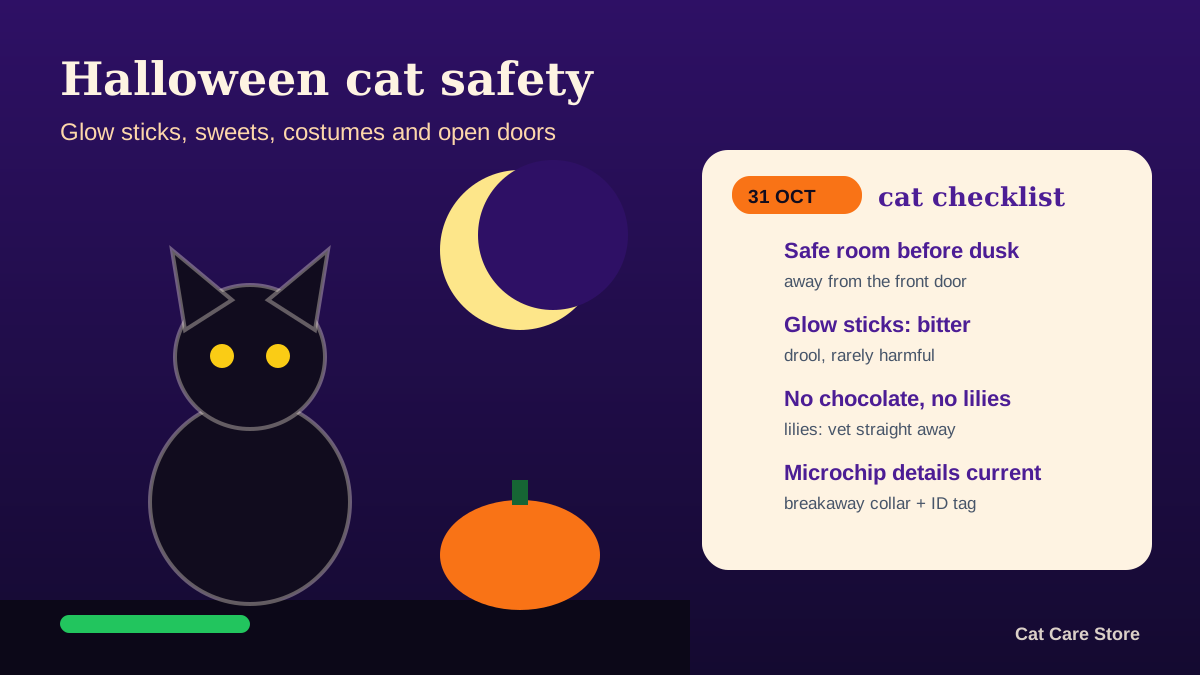
- Check the microchip registry has your current phone number, and put on a breakaway collar with an ID tag.
- Set up the safe room with litter, water, a bed, a box to hide in and a familiar blanket.
- Bring outdoor cats in before dusk; keep black cats in all week.
- Keep sweets in closed containers, off low tables and out of children's bedrooms.
- Swap real candles for battery lights; tidy away cables and spare batteries.
- Check any bouquet for lilies and keep it out of the house if it has them.
- Gather up glow sticks, wrappers and ribbon at the end of the night.
- Save your vet's number and the nearest emergency clinic's number in your phone.
Frequently asked questions
Should I keep my cat inside on Halloween?
Yes. The AVMA recommends keeping pets indoors on Halloween, and the ASPCA advises keeping most cats in a quiet room away from the front door during trick-or-treating. Bring outdoor cats in before dark.
Are glow sticks poisonous to cats?
Most are labelled non-toxic, and the AVMA says the liquid is unlikely to be harmful, but it tastes very bitter. A cat that bites one may drool a lot and run around. Wipe its mouth and fur and offer a little food. Call your vet if it swallowed plastic or stays unwell.
Is it safe to put a costume on my cat?
Only if your cat is relaxed about it, the costume doesn't restrict its sight, hearing, breathing, mouth or movement, and you stay with it the whole time. Most cats are happier with a breakaway collar or nothing at all.
Sources
- American Veterinary Medical Association, Halloween pet safety
- ASPCA, Halloween Safety Tips and Your Guide to a Pet-Safe Halloween (Animal Poison Control Center)
- ASPCA, Animal Poison Control
- US Food and Drug Administration, Lovely Lilies and Curious Cats: A Dangerous Combination
- Pet Poison Helpline, Chocolate
- WRAL / WITN, ENC rescue pauses black cat adoptions ahead of Halloween (23 October 2026)